Baccarat Online: Rules, Live Dealer Tables and Real-Money Play
Author: Nisha Rao, Casino Content Editor at Casino and Betting India · Last reviewed and updated: 2026 · Editorial testing: Indian-facing casino lobbies, RNG and live dealer tables

Author: Nisha Rao, Casino Content Editor at Casino and Betting India · Last reviewed and updated: 2026 · Editorial testing: Indian-facing casino lobbies, RNG and live dealer tables
«Before you deposit a single rupee or place your first wager, understand the mathematical reality behind the table. Baccarat offers some of the clearest odds in the casino, yet unverified bonus terms and payment friction can spoil the whole experience. Treat casino play as paid entertainment with strict bankroll boundaries.» — Nisha Rao, Casino Content Editor (source: editorial brief, Casino and Betting India)
Baccarat is a classic casino card game built around one simple question: which of the two hands, Player or Banker, will land closest to a point total of 9? The third option is a Tie. Drawing rules are fixed, the baseline house edge is low, and that combination has made baccarat online one of the most played table games in Indian-facing digital casinos and in global live dealer studios.
Simple game. Complicated marketing around it.
Most people searching for baccarat in India are not looking for a system. They are looking for reassurance on three points: is this available to me, will my money move safely, and what is the catch inside the bonus?
That is the order this guide follows. Rules first, because you cannot judge risk in a game you do not understand. Then payments, KYC and withdrawals in rupee terms, because that is where friction actually appears. Then bonuses, since table games are usually the worst-weighted category in a welcome offer. And finally strategy and limits, framed honestly: baccarat has a fixed house edge, so no staking pattern removes it.
One more note before we start. Online gambling law in India is fragmented across states and the central framework administered by MeitY, so nothing here should be read as legal certainty. Verify your state's position and the operator's licence yourself.

Baccarat is a comparing card game played between two abstract hands, labelled Player and Banker. You wager on the outcome; you never hold cards. Unlike blackjack or poker, the game is structurally "decision-free" once bets are placed, because every draw follows a strict predetermined table handled by the dealer or the software.
The appeal of a baccarat game in online casinos comes from that mix of low complexity and favourable odds. In standard eight-deck play, the house edge on the Banker bet sits at roughly 1.06% even after the standard 5% commission, while the Player bet carries 1.24%, according to the combinatorial calculations published by Wizard of Odds (https://wizardofodds.com/games/baccarat/). Since there is no decision tree to master mid-round, you can put your attention where it actually pays off: stake sizing, format selection, and reading the casino's safety signals.
«Live dealer baccarat holds the leading single share of the segment, roughly 28.5%, within a market valued at about $8.6 billion.» — Growth Market Reports, Live Dealer Casino Market Analysis (2025). https://www.growthmarketreports.com/report/live-dealer-casino-market
Published return-to-player figures explain why mathematically minded users gravitate to this table:
«Banker bet RTP is approximately 98.94%, Player bet 98.76%, while the Tie at 8:1 returns only about 85.64%.» — FreeTips.com, Baccarat House Edge Analysis (2024). https://www.freetips.com/casino/baccarat/house-edge/
A short history note. Baccarat grew out of a French parlour game in the first half of the 19th century, was trimmed from a three-person zero-sum format into a two-person one, and reached global casino floors in the early 20th century. Its dominant modern form, Punto Banco, was shaped in 1940s Havana, which is why you still see "Punto Banco" and "baccarat" used interchangeably in live lobbies. The format never stopped evolving: side bets, no-commission payouts, squeeze rituals, speed tables, multiplier cards, and even Dice Baccarat, where rolled dice replace the shoe entirely.
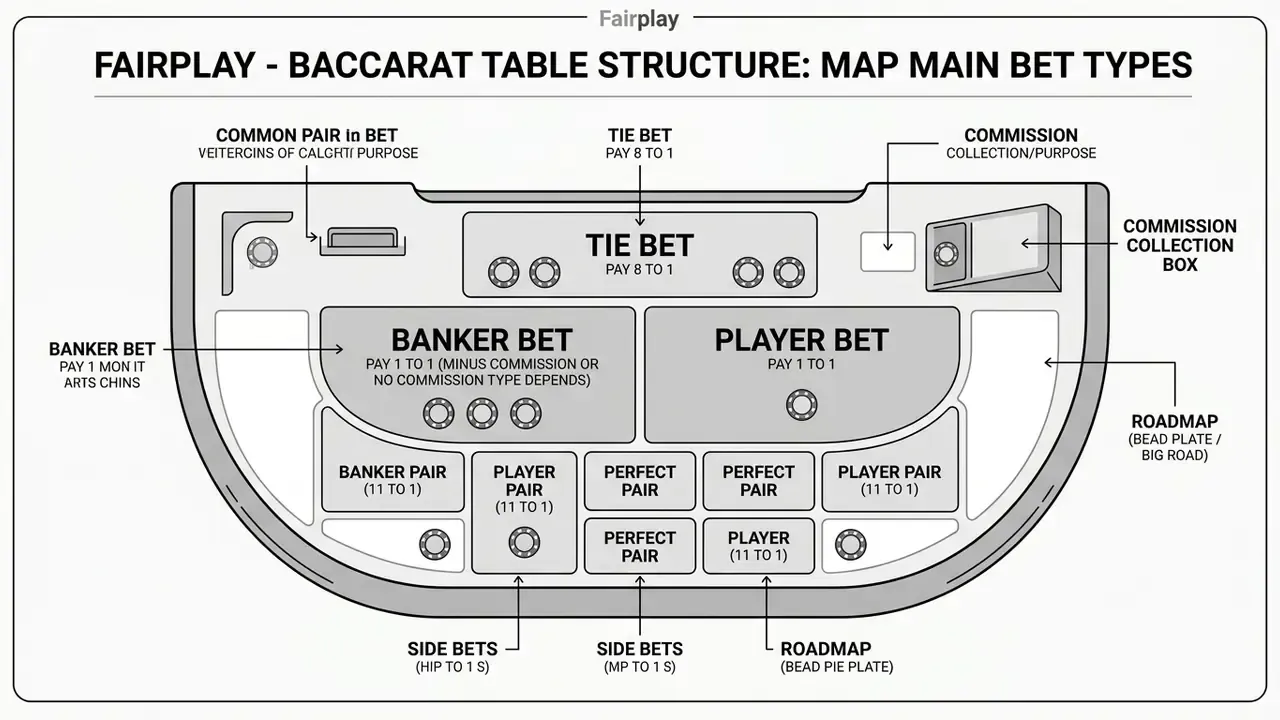
Every round gives you three primary outcomes: back the Player hand, back the Banker hand, or wager that both hands finish on an identical score (Tie).

«Banker wins 50.68% of all decided rounds once ties are excluded, versus 49.32% for Player, which is the mathematical basis for prioritising Banker.» — SportsLine, Baccarat Odds and House Edge Breakdown (2024). https://www.sportsline.com/casino/baccarat/odds/
One point confuses newcomers more than any other: "Player" and "Banker" are betting positions, not seats assigned to you. You can back Banker every single hand if you want, and many regulars do exactly that.
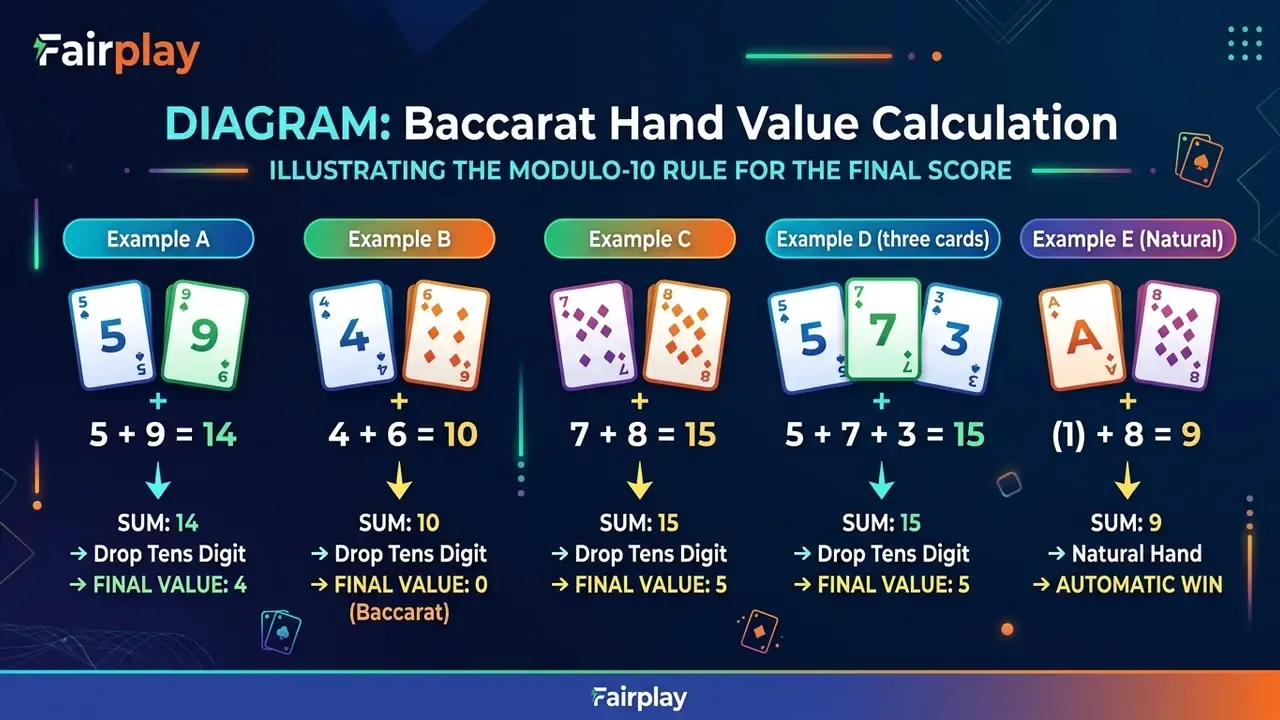
A hand's value is the sum of its card values with a modulo-10 rule applied, meaning only the rightmost digit counts. Scoring is standardised: Aces are worth 1 point, cards 2 through 9 keep their face value, and 10s, Jacks, Queens and Kings are worth 0.
When the sum passes 9, ten points drop off automatically. A 7 and an 8 make a raw 15, which becomes a hand value of 5. A total of 10 or 20 falls to 0, historically called Baccarat. And the highest total in the game, 9, is never exceeded, because the modulo-10 rule always resets the count. That single rule is why the game plays so fast once it clicks.
A standard round starts with two cards dealt to the Player hand and two to the Banker hand. After that, predefined third card rules decide whether either side draws again. You make no decisions during dealing; the dealer or the software follows formal procedural tables to the letter.
Because those baccarat rules are standardised, play is consistent across physical tables, digital RNG software and baccarat live dealer broadcasts. If either hand shows a "Natural" total of 8 or 9 on the first two cards, the round ends immediately with no further draws.
«The fixed third-card rules are fully deterministic and leave the player no strategic decisions once the bet is placed.» — Wizard of Odds, Baccarat, Rules and House Edge (current edition). https://wizardofodds.com/games/baccarat/
The dealing order is fixed: first card to the Player hand, second to the Banker hand, third to the Player hand, fourth to the Banker hand. Once both two-card hands are on the table, totals are compared at once.
If either side shows an initial two-card total of 8 or 9, a "Natural" is declared. A Natural 9 beats a Natural 8. If both hands hold equal Natural values, the result is a push, settled as a Tie. When a Natural occurs the round stops, bets are settled, and no third card is dealt to either side.
If neither hand hits a Natural, the game moves to the third card phase. The Player hand is always evaluated first, and only then does the Banker's action get decided.
| Banker two-card total | Banker draws when Player's third card is | Banker stands when Player's third card is |
|---|---|---|
| 0, 1, 2 | Any card | None |
| 3 | 1, 2, 3, 4, 5, 6, 7, 9, 10/J/Q/K | 8 |
| 4 | 2, 3, 4, 5, 6, 7 | 1, 8, 9, 10/J/Q/K |
| 5 | 4, 5, 6, 7 | 1, 2, 3, 8, 9, 10/J/Q/K |
| 6 | 6, 7 | All others |
| 7 | Never draws | Any card |
You do not need to memorise this grid to play. It is worth reading once, though, so you can confirm the software is behaving correctly.
During the dealing phase your role is passive. Every draw is predetermined and executed by the dealer or by the software. Your actual involvement is narrow: place chips on Player, Banker, Tie or an optional side bet inside the pre-round betting window.
In our editorial testing of online casino table interfaces for Indian users, automated systems applied these exact third-card tables without a single deviation across the sessions we logged. That is reassuring, but it also means the only thing you control is the bet. Set your limits before the shoe starts and you avoid deciding anything under a ten-second countdown.

Choosing between baccarat demo play and baccarat real money comes down to one question: are you learning mechanics, or are you wagering? Demo modes run on virtual credits with an identical interface and identical rules, minus the financial exposure. Once you have the rules down, the sensible next step is comparing online casinos for baccarat play on licensing, payment rails and table limits before any funds move.
A free baccarat demo suits anyone unfamiliar with third-card triggers, online table navigation or side-bet structures. In demo mode you can:
There is a trap here, and it is psychological rather than technical. A good run in demo mode is not evidence of skill, because outcomes are governed by fixed probabilities either way.
«Conversion from free play to cash play was predicted not by free-play participation itself, but by perceived success during free play.» — University of Georgia, Conversion from Free Play Mode to Cash Play Mode in Skill-Based Online Gambling (2023). https://esploro.libs.uga.edu/esploro/outputs/doctoral/Conversion-from-Free-Play-Mode/9949518803959
Related academic work on simulated gambling adds a nuance about sequencing:
«Social-casino play more often follows monetary gambling rather than preceding it.» — Order of first-play in simulated versus monetary gambling, PubMed Central (2024). https://www.ncbi.nlm.nih.gov/pmc/articles/PMC10857777/
Before you move to real funds in India, verify the platform conditions below. Treat it as one pre-deposit routine, not a set of separate errands.
Pre-deposit safety checklist (print-friendly):

⚠️ ALERT: Responsible Gambling Notice Real-money baccarat wagering carries genuine financial risk. Gambling must never be treated as income, investment or a shortcut to money. Set strict daily or monthly deposit limits, define session boundaries, and stop the moment your budget limit is reached. In India, the Promotion and Regulation of Online Gaming Rules issued by the Ministry of Electronics and Information Technology (MeitY) place emphasis on player protection, age verification (18+ or 21+ depending on jurisdiction) and self-exclusion tools.
Disclaimer: This information is general and does not replace advice from a qualified legal or financial professional. Online gambling legislation varies between Indian states and platform terms change frequently, so always verify current rules directly with the operator and with applicable state law.
Deposits are easy almost everywhere. Withdrawals are where players actually get stuck. In the complaints we read, the cause is nearly always documentation or a method mismatch, not the game itself.
Step 1: verify your identity early (KYC). Complete verification right after registration, not after a win. Operators serving Indian users typically request:
Step 2: match the deposit and withdrawal method. Most operators enforce a "closed-loop" policy, meaning funds return to the rail you deposited with. Deposit by UPI and expect the payout to route back to the same UPI-linked bank account. Depositing from one person's account and withdrawing to another almost always ends in a rejection.
Step 3: check minimums, caps and fees. Note the minimum withdrawal amount, any monthly payout ceiling, and whether the operator charges a processing fee or passes on a payment-gateway fee.
Step 4: understand realistic timelines. Two clocks run in sequence: the operator's internal review, often called the pending period, and the banking rail. UPI and IMPS are near-instant once approved. NetBanking and bank transfers can add a working day, and weekends or bank holidays stretch everything.
Step 5: know why payouts get delayed. The causes Indian users report most often are incomplete KYC, a name mismatch between the casino account and the bank account, an unfinished bonus wagering requirement locking the balance, a withdrawal request submitted while a bonus is still active, and bank-side declines on gaming-related merchant categories.
Step 6: keep a paper trail. Save transaction IDs (UTR or RRN for UPI and IMPS), timestamps and support chat transcripts. When a payment is stuck at the bank rather than at the casino, the UTR is the reference that resolves it.

Disclaimer: Payment availability, processing times and documentation requirements are operator- and bank-specific and change without notice. Verify the current cashier terms on the platform before depositing.
Modern baccarat casinos run several distinct versions of the classic game, adjusting dealing tempo, card reveal rituals, commission structures, multiplier mechanics and progressive payout features. Hand valuation stays constant across all games baccarat lobbies offer. What changes is pace, effective house edge and bankroll volatility.
«Average live dealer baccarat sessions run 25 to 35 minutes, and 62% of all live dealer sessions in 2025 were played on mobile devices.» — MEXC Research, Live Dealer Game Summary (2026). https://www.mexc.com/ru-RU/learn/article/live-dealer-games-research-2026
Standard baccarat tables keep traditional pacing: roughly 15 to 20 seconds to place bets, then a deliberate dealing phase, for a total round length near 48 seconds.
Speed Baccarat squeezes the betting window down to 10 to 12 seconds and deals cards face-up immediately, trimming the average round to 27 to 30 seconds. Evolution's version is built around a 27-second deal-to-deal cycle. The core house edge is unchanged, but the round count per hour is not, and that is what matters for your bankroll. Practically: at about 48 seconds you face roughly 75 decisions an hour, and at about 28 seconds you face roughly 128. Same unit size, nearly 70% more money staked per hour.
Pace is a stake decision in disguise. Most beginners miss that.

Baccarat Squeeze builds the round around the physical ritual of card handling. In live dealer baccarat squeeze formats, multi-camera setups, some studios use upwards of 15 HD cameras, capture the dealer slowly bending, twisting or peeling back a card edge to reveal the pips gradually. Tension is the product here. In land-based tradition the squeeze belonged to the player with the largest bet; online, the dealer performs it for the whole table.
In Controlled Squeeze variants, pioneered by providers such as Evolution, digital overlays on glass-embedded table cameras let you peel back the mask yourself with a touchscreen or mouse, on desktop, tablet or smartphone. The reveal window is time-limited inside each round. The squeeze has zero mathematical effect on the outcome, though it does lengthen rounds and heighten engagement. Side effect worth noting: slower rounds mean lower hourly exposure, which actually suits a cautious bankroll.
No Commission Baccarat drops the traditional 5% deduction on winning Banker bets and pays them at full 1:1. To protect the house advantage, operators add a compensating rule: when the Banker wins with a total of exactly 6, the bet pays half odds, 0.5:1.
«The compensating rules used in no-commission baccarat generally push the effective house edge above the standard 1.06% Banker figure.» — Wizard of Odds, No Commission Baccarat analysis. https://wizardofodds.com/games/baccarat/
Progressive Jackpot Baccarat layers an optional side wager onto the base game. A small slice of each side bet feeds a growing pool, which pays against a posted paytable when rare combinations appear, for instance suited Natural 9s on both hands. Regulators treat this as a side wager settled independently of the base hand. These progressive bets usually carry house edges above 10 to 15%, so they are high-variance entertainment rather than value. Banker-6 side bets follow the same logic. The "Tiger" wager, paying 12:1 on a two-card Banker 6 and 20:1 on a three-card Banker 6, buys a bigger headline number at a materially worse edge.
This is the fastest-growing sub-category in live lobbies, and the one where the cost structure is most often misread.

The practical takeaway: a 20% fee means that for every ₹100 you intend to risk, ₹20 buys the feature and only ₹80 backs the hand. Multipliers do not defeat the house edge. They redistribute variance, making results spikier in both directions.
| Variant Name | Average Round Pace | Banker Commission / Fee | Card Reveal Style | Live Dealer Availability |
|---|---|---|---|---|
| Standard Baccarat | ~48 seconds | 5% on winning bets | Standard face-up reveal | High across all platforms |
| Speed Baccarat | ~27–30 seconds | 5% on winning bets | Immediate face-up reveal | High in live casino lobbies |
| Baccarat Squeeze | ~60–90 seconds | 5% on winning bets | Slow manual dealer peel | High in VIP live studios |
| Controlled Squeeze | ~60–90 seconds | 5% on winning bets | Player-controlled digital peel | Selective (Evolution) |
| No Commission Baccarat | ~45–50 seconds | 0% (except 0.5:1 on Banker 6) | Standard face-up reveal | Moderate to high |
| Progressive Baccarat | ~48–55 seconds | 5% on base bet plus jackpot side fee | Standard face-up reveal | Selective live platforms |
| Lightning / Golden Wealth | ~30–48 seconds | 20% fee on total stake | Face-up reveal plus multiplier cards | High (Evolution) |
| Peek Baccarat | ~50–70 seconds | 20% one-time fee | Dealer peeks 1 to 4 cards, player raises | Selective (Evolution) |
Baccarat live dealer games sit between digital convenience and the atmosphere of a real floor. Studios stream human dealers, physical shoes and optical card-scanning technology straight to mobile or desktop screens. Purpose-built facilities run around the clock, and one Playtech live dealer studio operates 24 hours a day, 365 days a year, while some operators keep deliberately small table sets. A 2025 Michigan studio, for example, launched with five blackjack tables, one roulette table and one baccarat table.
«The live dealer market is projected to grow to $21.3 billion by 2034 at a 10.3% CAGR, with baccarat holding the leading share at about 28.5%.» — Growth Market Reports, Live Dealer Casino Market 2025–2034. https://www.growthmarketreports.com/report/live-dealer-casino-market
More than 62% of live dealer sessions now happen on mobile devices, which explains why stream stability on Indian mobile data deserves a test run before you stake anything meaningful.
At a live table, a professional dealer manages a physical 6- or 8-deck shoe at a branded baccarat table. The 8-deck game dominates online because deeper shoes further neutralise card-tracking attempts. As the dealer draws, optical scanners or bar-code readers under the glass detect each card's suit and rank automatically.
That scanned data is processed in real time by game control units (GCUs) and mirrored instantly on your interface overlay. Bets are placed digitally on screen, wins are resolved by software according to the published paytable (Banker at 0.95:1, Player at 1:1, Tie at 8:1), and your balance updates as each physical hand finishes. Shoes are usually replaced when roughly one deck remains.
Live dealer tables use a standard signal system, so you always know where you are in the round. Learning it prevents the most common beginner mistake: a bet that never registers.
Practical interface notes from our testing:
Live dealer baccarat runs on video and dealer-led timing. RNG-based 3D titles such as Evolution's First Person Baccarat offer a hybrid alternative:
The difference goes beyond aesthetics:
«Live dealer games correlated with markers of harm roughly twice as strongly as their RNG equivalents (Spearman ≈0.21 versus ≈0.10).» — Kindred/Unibet behavioural markers study (n≈100,000), International Journal of Mental Health and Addiction (2024). https://link.springer.com/article/10.1007/s11469-024-01257-x
So if you know that social presence and a continuous stream keep you at the table longer, the RNG format is the safer default for a budget-limited session. Nothing happens until you press deal, and that pause is worth more than it sounds.
When comparing live baccarat tables across platforms, focus on these criteria:
| Feature / Metric | Baccarat Demo | RNG / First Person Baccarat | Live Dealer Baccarat |
|---|---|---|---|
| Real money stake | No (virtual credits) | Yes (real INR bankroll) | Yes (real INR bankroll) |
| Human dealer present | No | No (3D graphical UI) | Yes (live streamed dealer) |
| Game speed | Player-controlled | Fast, player-triggered | Fixed studio countdown |
| Minimum entry threshold | Free access | Low (e.g. ₹10 to ₹50) | Moderate to high (e.g. ₹100 to ₹5,000+) |
| Roadmaps / statistics | Basic or simulated | Full digital roadmaps | Live optical studio roadmaps |
| Best suited for | Learning rules and interface | Pace control, low-stake practice | Atmosphere, VIP limits, social play |
Read the matrix in one line: demo teaches the rules, RNG protects your pace, live dealer sells the atmosphere at a higher minimum.
Picking a secure baccarat casino means verifying licensing credentials, testing payment mechanics that matter in India (UPI, NetBanking, IMPS, wallet options), checking lobby depth, and reading the promotional fine print rather than the banner.
«Before you deposit a single rupee, understand the mathematical reality: unverified bonus terms and payment friction can easily disrupt your experience.» — Nisha Rao, Casino Content Editor, Casino and Betting India (editorial position)
A solid catalogue mixes RNG and live dealer software. Look for platforms offering:
Baccarat casinos that hide their paytables behind a support ticket are telling you something. Believe them.

Banners promising huge match bonuses often carry terms that work against table game players. When you analyse an offer for baccarat play:
Worked example, what "30x" really costs on a baccarat table:
Deposit:                    ₹1,000
Bonus (100% match):         ₹1,000
Wagering requirement:       30x (bonus)          = ₹30,000 of turnover
Baccarat contribution:      10%
------------------------------------------------------------------
Effective turnover needed:  ₹30,000 ÷ 0.10       = ₹300,000
Effective requirement:      300x the bonus
Expected theoretical cost:  ₹300,000 × 1.06%     ≈ ₹3,180 on Banker bets
In plain terms, clearing that bonus on baccarat costs more in expected losses than the bonus is worth, and that is before max-bet limits and expiry get involved. If baccarat is your main game, an offer with no bonus at all, or cashback with no wagering attached, is frequently the better commercial choice. Not the answer promo pages want, but it is the honest one.
Bonus verification checklist:
«Bonus-term complexity is experienced by players as friction and drives session abandonment before play even begins.» — CasinoRank, Online Casino Engagement and Attention Crisis Report (2026). https://www.casinorank.com/research/engagement-report-2026/
🔍 FACT CHECK: Bonus Verification Requirement Never assume a welcome offer applies equally across all casino sections. Go directly to the platform's official Terms and Conditions page. Verify the specific game contribution table to confirm the exact baccarat weighting before claiming anything. Regulatory guidance in mature markets also requires that bonus winnings stay subject to any incomplete wagering requirement until it is met.
No betting system alters the fixed house edge built into baccarat rules. A sensible baccarat strategy does three things instead: it selects the statistically better bets, it manages the session bankroll with discipline, and it rejects the folklore around shoe patterns.
«Even sophisticated card-counting schemes produce negligible swings in the house edge, unusable in practice in multi-deck baccarat.» — Wizard of Odds, Baccarat Card Counting Analysis. https://wizardofodds.com/games/baccarat/card-counting/
Every hand is statistically independent of the last. Roadmaps are a record, not a forecast, and over-valuing streaks is one of the most expensive habits budget players pick up.
From a pure expected value perspective, the ranking across standard 8-deck shoes is stable:
A simple, defensible default: choose Banker or Player, stay there, and stop treating Tie and side bets as value plays. Progressive and Tiger-style wagers routinely run at 10 to 15% house edge or worse.

None of these systems changes the house edge. What they change is the shape of your session: how fast stakes escalate, how streaks are monetised, and how quickly you can hit a table ceiling. Use them as staking discipline, never as an edge.

| System | Direction | Escalation risk | Built-in reset | Suits |
|---|---|---|---|---|
| Flat betting | None | Very low | Not applicable | Long, low-variance sessions |
| Paroli | After wins | Low (house money) | 3 wins or any loss | Budget players |
| 1-2-3-4 | After wins | Low | End of sequence or any loss | Streak capture |
| Fibonacci | After losses | Moderate | Two steps back on a win | Medium bankrolls |
| Mini-Martingale | After losses | Moderate | Hard 3-loss cap | Disciplined players |
| Martingale | After losses | Severe | None | Not recommended |
Disclaimer: This information is general and is not a substitute for professional advice. If you notice signs of gambling dependence, contact a licensed clinician or a psychological support helpline.
Bankroll management is your primary protective tool during real-money play:

«Key behavioural risk markers include mid-session deposits, removing responsible-gambling limits, and betting at atypical hours.» — Kindred/Unibet behavioural markers of harm study (2024). https://link.springer.com/article/10.1007/s11469-024-01257-x
«Gambling should never be treated as a source of income; group cognitive behavioural therapy has the strongest evidence base for reducing severity of harm.» — NICE guideline on gambling-related harms, BMJ (2024). https://www.bmj.com/content/384/bmj-2023-076620
Responsible-gambling standards support setting daily, weekly or monthly deposit limits at registration, with reductions taking effect immediately, and recommend age gating at 18+ (21+ in some frameworks) for both free and paid play. The mistakes worth designing out in advance: chasing losses, betting on emotion after a bad run, misreading the odds on Tie and side bets, and treating roadmap patterns as predictive.
Probability and house-edge figures in this guide follow the standard combinatorial analysis for the 8-deck shoe published by Wizard of Odds (https://wizardofodds.com/games/baccarat/), cross-checked against operator paytables and RTP breakdowns from FreeTips.com and SportsLine. Market and session data come from Growth Market Reports and MEXC Research. Behavioural and clinical statements are sourced from peer-reviewed publications (International Journal of Mental Health and Addiction, BMJ) and academic research from the University of Georgia and PubMed Central, not from operator marketing material. Where a claim depends on a specific operator's terms, such as table minimums, KYC document lists, contribution percentages or withdrawal timelines, we flag it as requiring per-operator verification, because those vary by licence, provider and payment rail. Interface behaviour (betting windows, traffic-light indicators, rebet controls, third-card automation) was verified in hands-on editorial testing of Indian-facing RNG and live dealer lobbies.

Responsible gaming: 18+ or 21+ depending on jurisdiction. Gambling involves financial risk and should be treated as paid entertainment, never as income. Use deposit, loss and session limits, time-outs and self-exclusion tools. This article is informational and educational only and does not constitute legal, financial or medical advice.